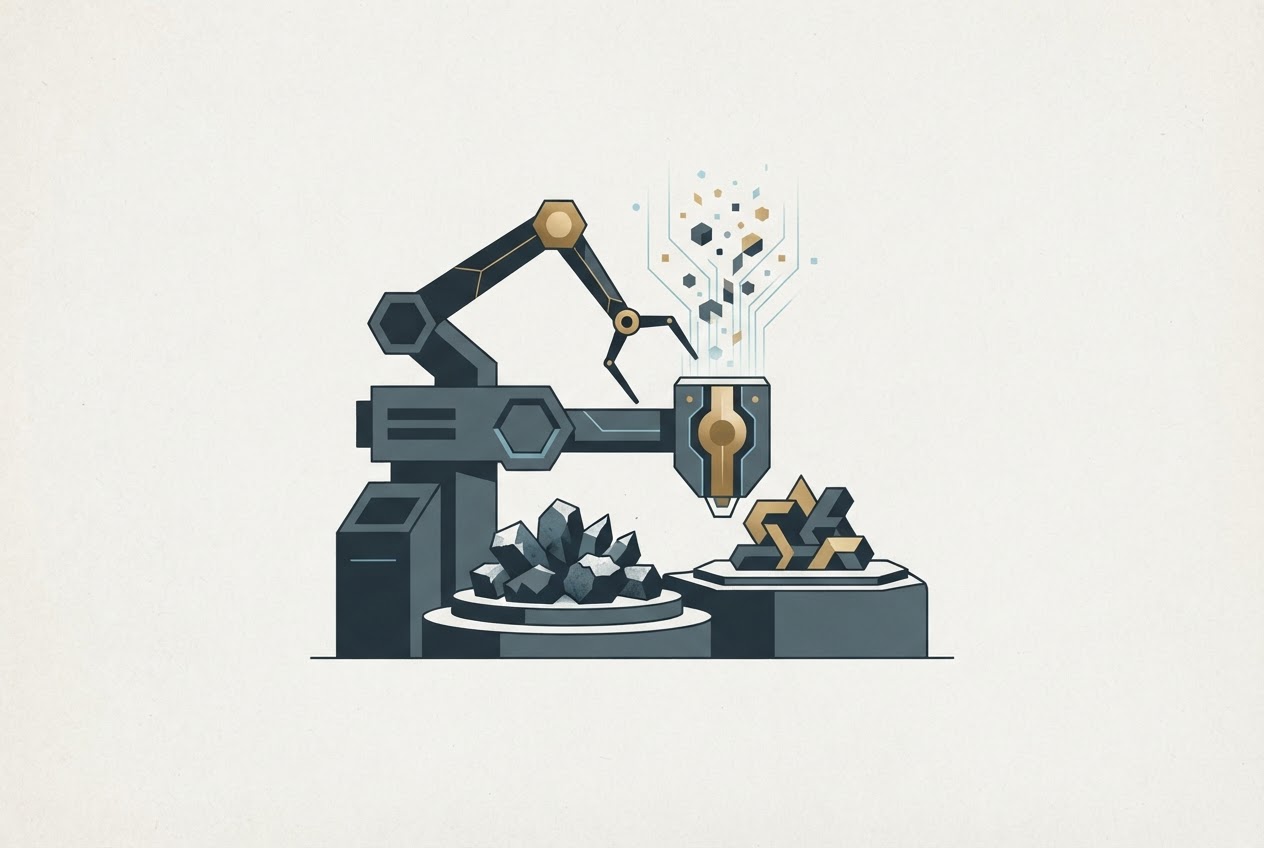
New York-based Radical AI is developing alloys that use fewer supply-constrained metals, offering a downstream approach to US efforts to reduce dependence on China for critical minerals, MINING.COM reported. The company says its combination of artificial intelligence and robotic experimentation allows manufacturers to incorporate raw material availability into materials design while preserving required industrial performance.
Chief executive Joseph Frause told MINING.COM that the company’s laboratory at the Brooklyn Navy Yard had generated 300 new alloy compositions in about 16 weeks. Backed by RTX and Nvidia, the work focuses on advanced materials for aerospace, defence and other industrial uses. Rather than mining or processing minerals, Radical AI combines refined metals to identify compositions that meet customers’ requirements with less exposure to constrained supplies.
Hafnium is one target. Radical AI says it has developed high-performance alloys for extreme-temperature applications containing only small amounts of the metal, with some formulations using almost none. Manufacturers can specify elements to leave out while seeking to maintain strength, durability and resistance to heat and oxidation. The company presents this as a potential route around vulnerabilities linked to export controls, geopolitical tensions and limited domestic production.
Its platform links computational design with physical experiments. After selecting a promising composition, the laboratory makes a sample weighing roughly 50–200 grams and examines its chemistry, grain structure and mechanical characteristics. Tests can cover hardness, tensile strength and performance at high temperatures. Results then inform subsequent machine-learning calculations and experiments. Frause said the longer-term objective was to compress a 20-year materials development cycle into one to three years.
Founded in January 2024, Radical AI says its autonomous laboratory platform is commercialised and has paying customers. Customers can retain intellectual property rights to compositions developed through the system. The company does not produce alloys in commercial volumes or sign offtake agreements, and discoveries still need further development and qualification before industrial use, particularly in aerospace and defence.
Separately, Radical AI partnered with Sandia National Laboratories in September to investigate interactions between metals and hydrogen and develop materials for separating hydrogen from waste gas streams. Its broader ambition is to let manufacturers develop materials alongside new products, bringing mineral availability into design decisions earlier rather than addressing supply constraints after specifications are fixed.