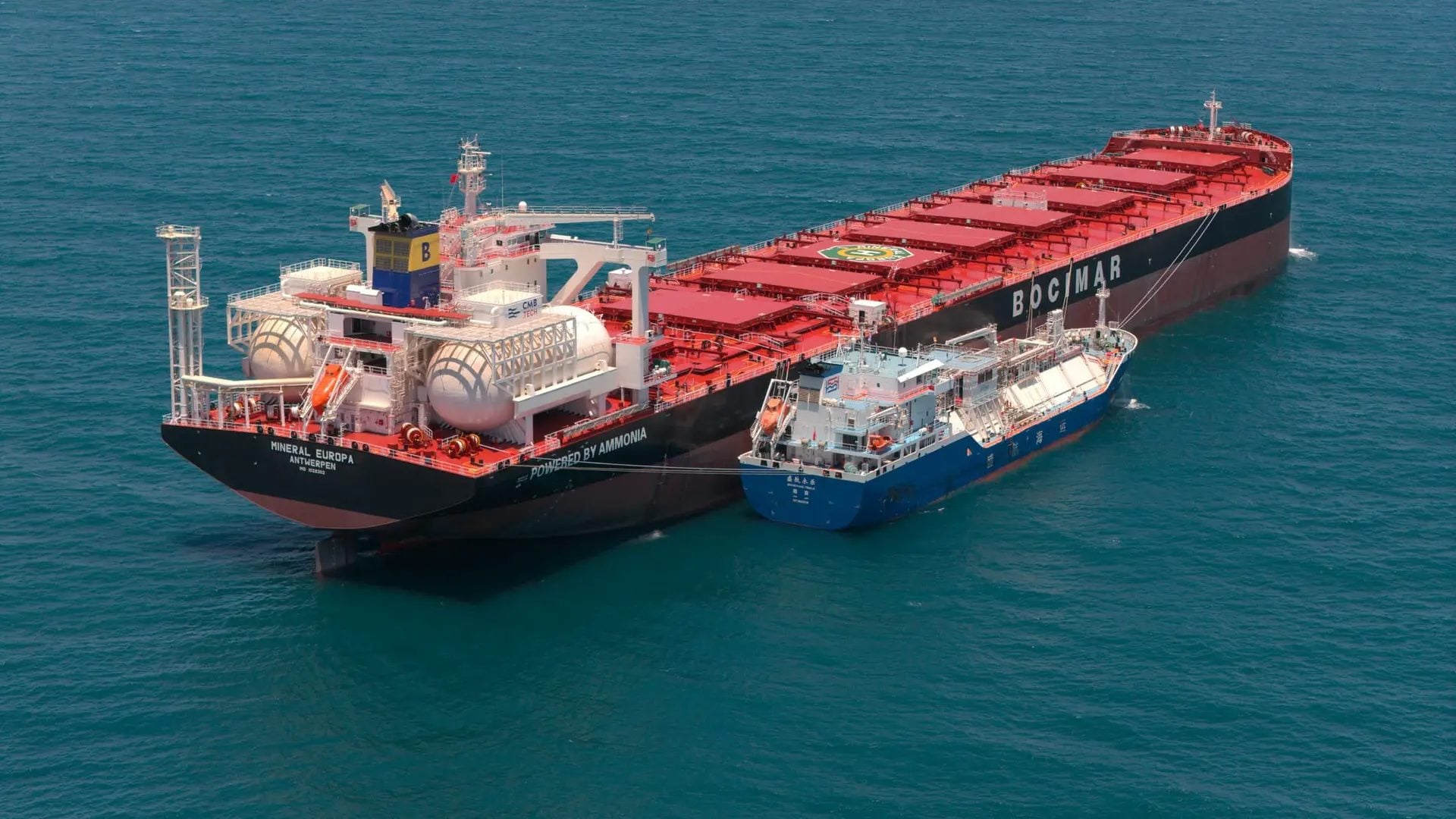
Australia has carried out its first green ammonia bunkering operation for an ammonia-powered bulk carrier at Western Australia’s Port Hedland, gCaptain reported. The 300-metre Mineral Europa took on certified green ammonia from a bunker vessel earlier this week before entering the port to load iron ore for China. Operated by CMB.TECH and chartered by Fortescue, the vessel is described as the world’s first ammonia-powered dry bulk carrier.
The ship-to-ship fuel transfer lasted about two hours and finished at 8.42am local time, according to a joint announcement by Fortescue, Pilbara Ports and CMB.TECH cited by gCaptain. Preparations included checks on vessel compatibility, modelling of ammonia dispersion, emergency response arrangements and extra marine support. Port authorities said all operational and safety conditions had been satisfied before the trial went ahead. The companies did not reveal how much fuel was transferred.
The operation brings ammonia bunkering to a major loading point for Australian iron ore shipments to Asian steelmakers. Fortescue is pursuing ammonia-powered shipping and dependable green fuel supplies to lower emissions from those voyages. Ammonia has no carbon content and releases no carbon dioxide when used as fuel, but its overall emissions performance depends on production methods and the management of other emissions, including nitrous oxide. Toxicity adds handling challenges for vessels, ports and suppliers.
Fortescue Metals chief executive Dino Otranto said the transfer showed ammonia bunkering progressing from limited trials towards use at major commercial ports. He argued that industry had demonstrated the technology ahead of regulation, while policy certainty and long-term fuel purchase commitments remained necessary to encourage investment in production and bunkering facilities.
Fortescue’s earlier work included ammonia propulsion trials by the converted offshore support vessel Fortescue Green Pioneer in Singapore in 2024. Alongside Mineral Europa, it charters nine CMB.TECH vessels that could later be converted to ammonia, while an agreement announced earlier this year covers up to 12 ammonia-capable bulk carriers. The latest operation also follows a September 2024 ship-to-ship ammonia transfer trial at Dampier. Pilbara Ports is studying a regional clean-fuel bunkering hub, although fuel costs, supply, safety and regulatory standards remain obstacles to wider adoption.